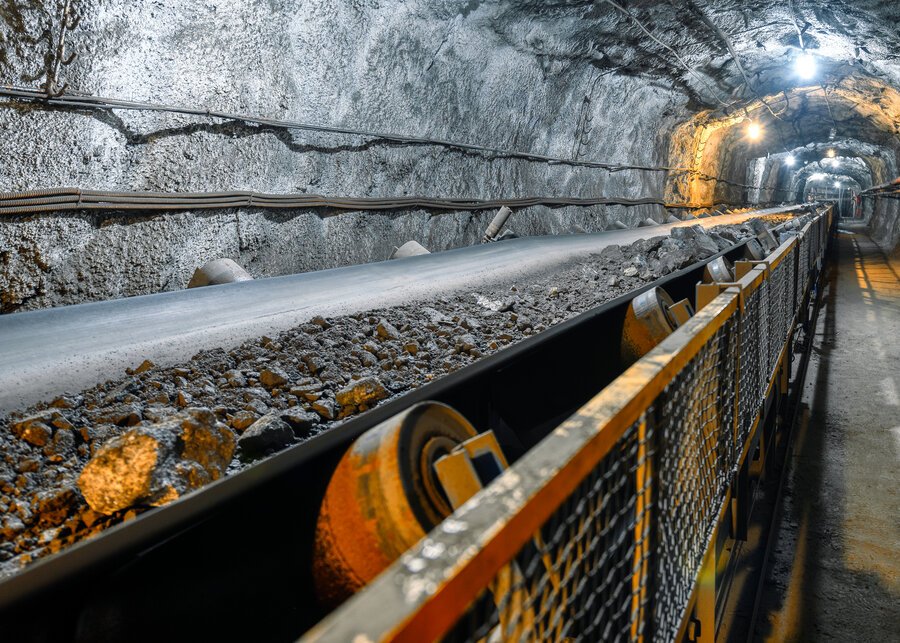
Förderbänder
Feuerfester Gürtel

Produktmerkmale
- Compliance: Meets leading international safety standards including EN 14937, EN 12882, ISO 340, FRAS, and MSHA
- Static Safety: Enhanced static conductivity safely dissipates static electricity, reducing spark risks
- Durability: Durable design ensures long service life without
Technical Information
| Fire Resistant Test Compliance to Standard | Minimum Tensile Strength | Minimum Elongation at Break (%) | Maximum Abrasion Loss (mm3) | Application Characteristics |
| FR MSHA 2G | 15 | 350 | 190 | Moderate resistance to flame for over ground application |
| FR CAN - C | 17 | 400 | 175 | Good resistance to flame for over ground applications |
| FR DIN K | 17 | 400 | 175 | Good resistance to flame for over ground applications |
| FR IS 1891 | 17 | 400 | 175 | Good resistance to flame for over ground applications |
| FR - AS F | 17 | 400 | 175 | Very good resistance to flame suitable for high risk over ground/low risk underground application |
| FR - DIN S | 17 | 400 | 175 | Very good resistance to flame suitable for high risk over ground/low risk underground application |
| FR - SANS 971:2003 | 17 | 400 | 175 | Very good resistance to flame suitable for high risk over ground/low risk underground application |
| FR MSHA BELT (PART 14) | 15 | 400 | 200 | Excellent resistance to flame propagation suitable for underground mining application |
| FR - SANS 971:2013 | 15 | 400 | 170 | Excellent resistance to flame propagation suitable for underground mining application |
| FR AS 4606:S | 20 | 400 | 120 | Excellent resistance to flame propagation suitable for underground mining application |
Summary of Safety Classes
| CLASS | APPLICATION | SURFACE RESISTANCE EN ISO 284 | Flame | Glow | Max. drum temperature °C | Aggregate of each set of six test pieces | Maximum for any one test piece | FIRE PROPAGATION METHOD |
| A | General use, only hazard being limited access and means of escape | ≤ 300 MΩ | No | Permitted | No limit | < 45/45b | 15 | EN 12881-1:2014, Method A. If incomplete ignition achieved, use Method B or C |
| B1 | As class A plus potentially flammable atmosphere. No secondary safety devices | ≤ 300 MΩ | No | No | 450 | < 45/45b | 15 | EN 12881-1:2014, Method A. If incomplete ignition achieved, use Method B or C |
| B2 | As class A plus potentially flammable atmosphere. With secondary safety devices | ≤ 300 MΩ | No | Permitted | No limit | < 45/45b | 15 | EN 12881-1:2014, Method A. If incomplete ignition achieved, use Method B or C |
| C1 | As class B1 plus combustible dust or material conveyed. No secondary safety devices | ≤ 300 MΩ | No | No | 325 | ≤ 18/30b | 10/15b | EN 12881-1:2014, Method B or C |
| C2 | As class B1 plus combustible dust or material conveyed and additional fuel sources (fire load). With secondary safety devices | ≤ 300 MΩ | No | Permitted | No limit | < 45/45b | 15 | EN 12881-2, or EN 12881-1:2014, Method D for belts according to Table 1 |